
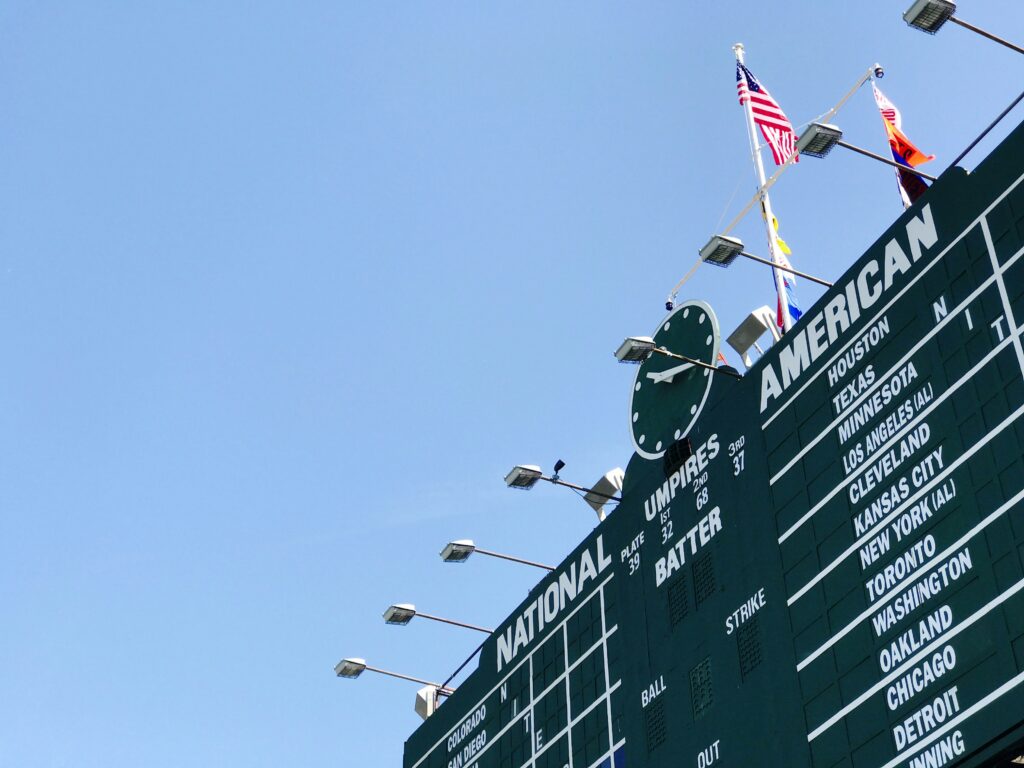
Pastors, elders, and congregations all second-guess Sunday from the wrong seat. What they need is a different scoreboard.
Every fan in America can tell you on Monday what the quarterback should have done on Sunday, especially if you are a Lions fan. He should have thrown it away. He should have seen the safety rotate. He should have taken the checkdown instead of forcing it into double coverage. The fan is right about all of it, and he had advantages the quarterback did not: a replay angle, a slow-motion button, no linebacker coming off the edge, no clock. Hindsight is cheap. It is also useless to the man who has to make the call with three seconds and a rush in his face.
Pastors live in a town full of Monday morning quarterbacks. Some of them sit in the pews and some of them sit on the elder board and the loudest one is usually the pastor himself, driving home after the second service, replaying the sermon and the hallway conversation and the family that was not there again. I’ve done that drive. I’ve also sat with enough pastors on Monday mornings to know that the replay is rarely the problem.
The problem is the scoreboard. Most of us grade the game by the wrong one, and under pressure the scoreboard you’ve trained yourself to watch decides your call for you.
You know your numbers. Every pastor does. Attendance, giving, and some version of membership or baptisms; the three that come up in the elders’ meeting and make a Monday feel good or sick. Ask yourself which of them you would defend from Scripture as a measure of whether your church is making disciples, and you will find yourself where most of us land: none of them, but they’re what we can count.
The coaching manual we use, The Journey, puts it bluntly in its opening pages: the Western church has slipped into a come-and-see approach and is “left with few biblical measurements of success beyond how many attend our churches, how much they give, and whether they are reasonably happy.” None of those numbers is wicked. All three are secondary. A church can post good numbers in every one of them and be full of people who do not look like Christ.
A secondary scoreboard does its damage under pressure. When giving dips, it tells you to protect the gathering: better music, a sharper program, a building campaign, one more thing that draws people in on Sunday. When a family leaves, it tells you to hold tighter. When a gifted young man wants to go plant somewhere, it tells you that you can’t afford to lose him. Each of those calls looks right from the stands. Each one is the checkdown that keeps the drive alive and never gets you into the end zone.
Jesus gave the church its scoreboard. “Not everyone who says to me, ‘Lord, Lord,’ will enter the kingdom of heaven, but the one who does the will of my Father who is in heaven” (Matthew 7:21). A seat filled on Sunday faith settles nothing on its own, neither does a name on a small-group roster. The Sermon on the Mount describes people who live visibly different lives in a fallen world, and a pastor is accountable for whether the people in his care are becoming those people.
The Journey names five marks of that kind of growth and calls them threshold values, because they are the floor.
- A believer is spending time with God daily in His Word.
- The fruit of the Spirit is increasing in him, so that his marriage and his workplace can tell.
- He knows his spiritual gifts and uses them, in the church and in the ninety percent of his week that happens outside it.
- He can tell the story of what God has done to save and forgive and use him, and he tells it.
- And he holds his money, his marriage, his time, and his possessions with open hands.
The Journey adds one qualification I’ve come to appreciate: the question is which way a man is postured, not how far along he is. A church full of people taking baby steps in those five directions is a church God is using, whatever the attendance chart says. A church full of comfortable, well-fed people standing still is in trouble.
That scoreboard changes the call. When giving dips and your people are growing in those five things, you don’t panic. When the gifted young man wants to go, you send him, because that is what a church of open-handed people does.
Ask a pastor what he gave his life for and he will tell you about his congregation: its health, its doctrine, its unity, its future. Those are good answers, and almost none of them are about the place God put him in. Paul told the Athenians that God “made from one man every nation of mankind to live on all the face of the earth, having determined allotted periods and the boundaries of their dwelling place” (Acts 17:26). No town came to be by accident, and no church landed in its town by accident either. When Paul wanted to leave Corinth, the Lord told him to stay, “for I have many in this city who are my people” (Acts 18:10). God had people in that city before Paul had a plan for it, and He held Paul responsible for the city and not only for the congregation he had gathered so far.
Somewhere on a map of your county there is a line around the part of it you would answer to God for. Inside that line are a certain number of people and a certain number of gospel-preaching churches, and the second number is a great deal smaller than the first divided by a thousand. Saturation church planting works from that rough benchmark, one congregation for every thousand people, so that everyone in a place can see and hear the gospel without having to go anywhere. Most Christians have never done the arithmetic. The pastors who do tend to ask the same question afterward: if every church inside this line kept growing at its current rate, how many years until that gap closes? The answer is usually a very long time. That is the field. The scoreboard on the wall can’t see it, and a church leader who can’t see it will make every call for the gathering and none for the geography.
The church at Antioch had the two best men it would ever have, and the Spirit said to send them. They fasted, prayed, laid hands on Barnabas and Saul, and let them go (Acts 13:1–3). By the stat sheet it was the wrong call; they gave away their best preacher and their best teacher in the same week. By the field it was the only call, and the gospel went to the ends of the Roman world because a leadership team in Syria was watching the right scoreboard when the pressure came.
That is what I want for the pastors I coach: a settled view of what counts, held in advance, so that when the linebacker comes off the edge the call is already made.
An Invitation to Investigate
The Journey is how EveryEthne helps a leadership team get there. It is a twelve-to-eighteen-month coaching process built on the seven marks of the Antioch church, taken one at a time, with an EveryEthne coach walking alongside the whole eldership. It is thinking rather than a model; no one hands you a program to copy. It costs something: at least four hours a month, every elder present, and a look at your own congregation. I say that up front because the teams that finish are the ones who heard the cost first.
Don’t commit to it from a blog post. Investigate it. Then give an EveryEthne coach ninety minutes with you and your elders in the same room. Then decide together, without us.
You can start that conversation at everyethne.life, or by writing to me at ray.brandon@eveyethne.org. Bring your numbers. We’ll talk about which ones count.